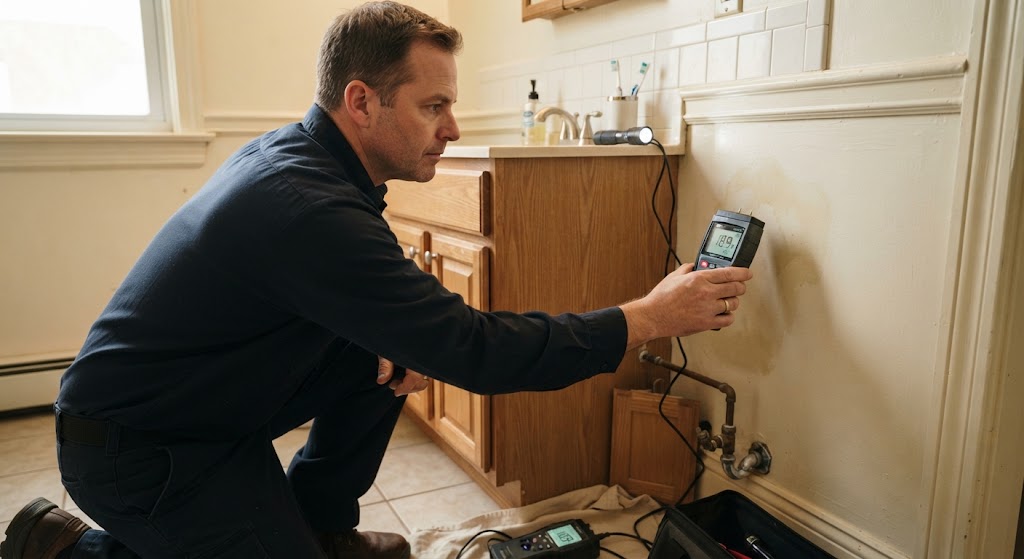
Solving the Water Mystery in Westfield Basements
In older Westfield communities like Stoneleigh Park and homes near the Downtown Westfield shopping district, basements serve as hubs for mechanical systems, laundry suites, or finished entertainment spaces. When standing moisture accumulates in a corner, homeowners often assume it is standard groundwater penetration. However, resolving water in basement plumbing leak Westfield scenarios requires knowing whether the water originates from potable plumbing under pressure or exterior soil saturation.
A continuous basement pipe leak Westfield issue can cause catastrophic mold proliferation behind finished drywall and rot sill plates if left unaddressed. Conversely, hiring a contractor to install expensive interior French drains when the true culprit is a dripping overhead copper line or cracked drain stack wastes substantial resources. We provide clear scientific answers so your repair strategy is targeted and effective. In New Jersey, subsequent plumbing alterations require a NJ licensed master plumber.
Unsure Why Your Basement Is Wet?
Do not guess between groundwater and plumbing failure. Call our Westfield diagnostic specialists to pinpoint the exact source today.
📞 Call (201) 510-1615Plumbing Leak vs. Groundwater Seepage: How We Differentiate
Understanding whether you have a foundation issue or a plumbing failure is the core of our diagnostic protocol. We compare key physical characteristics:
| Diagnostic Factor | Pressurized Plumbing Leak | Groundwater Seepage |
|---|---|---|
| Occurrence Timing | Continuous 24/7 flow, regardless of weather conditions | Surges during heavy rain or spring thaw cycles |
| Water Chemistry | Tests positive for municipal disinfectant (chlorine/chloramine) | Tests negative for chlorine; high dissolved mineral runoff |
| Water Meter Activity | Meter dials or flow indicators rotate continuously | Meter remains completely motionless when fixtures are off |
| Thermal Signature | Shows localized temperature plume around pressurized pipe | Shows broad, uniform cold moisture band at foundation cove joint |
Common Sources of Basement Moisture in Westfield Homes
Our investigations into wet basement leak Westfield NJ calls reveal a consistent variety of hidden failure points:
Supply Lines Behind Finished Drywall
Copper water pipes running between basement floor joists or boxed behind drywall columns develop pinhole leaks that run along framing before pooling on the slab floor.
Water Heaters & Relief Valves
Aging domestic water heaters frequently suffer hairline bottom weld leaks or malfunctioning temperature and pressure (T&P) discharge valves that weep continuously into floor crevices.
Sump Pump Discharge & Check Valves
Cracked PVC discharge lines or failing check valves allow pumped water to surge back down the pipe wall and spill behind basement walls instead of exiting the property.
Floor Drains & Buried Traps
Cast iron floor drain bodies installed decades ago can rust out beneath the concrete slab, allowing gray water to seep horizontally through floor cracks.
Our Multi-Step Basement Diagnostic Procedure
We execute an objective, non-destructive investigative sequence to trace basement moisture:
Water Meter & Pressure Verification
We isolate all domestic plumbing fixtures and perform digital pressure drop testing to verify if the potable water system is airtight.
Chemical Quality Testing
We test standing puddle water for municipal chemical markers. The presence of chlorine confirms treated water from a municipal supply pipe rather than natural groundwater.
Thermal Moisture Mapping
Using thermal imaging sensors, we map the moisture pathway behind finished basement paneling and ceiling tiles to locate the originating point.
Acoustic Listening on Overhead Chases
We apply acoustic microphones along supply manifolds to detect the high-frequency sound of pinholes in hidden plumbing lines.
Need Clarity on Your Westfield Basement Water Issue?
Talk directly with a local leak detection specialist. Call today for fast, accurate diagnostic locating.
📞 Call (201) 510-1615Repair Pathways Following Detection
Once we identify the exact failure point, you receive actionable technical guidance for remediation:
- Overhead Pipe Section Repair: If a copper or galvanized line has developed a pinhole, a NJ licensed master plumber can complete a surgical splice without disturbing the basement foundation.
- Water Heater Replacement: If the internal tank liner has failed, replacing the appliance eliminates the basement moisture permanently.
- Foundation Waterproofing Referral: If diagnostic testing confirms pure groundwater seepage with zero plumbing loss, we advise consulting a basement drainage specialist rather than opening plumbing lines.
Cost Factors in Basement Leak Detection
Diagnostic costs vary according to whether the basement is unfinished with exposed framing or fully finished with drywall, drop ceilings, and subflooring. The number of plumbing fixtures, buried slab lines, and presence of multiple moisture sources also influence testing scope. Accurate testing prevents costly false starts like unnecessary foundation excavation.
Basement Moisture Prevention in Westfield
Ensure basement humidity stays below 50% using a commercial-grade dehumidifier. Insulate exposed cold water pipes in spring to prevent condensation that mimics leaks, and test your sump pump and battery backup system prior to major rainstorms.
When Basement Water Requires Emergency Action
If water is rapidly rising near your electrical panel, furnace, or water heater, or if a ceiling pipe has burst overhead, treat the situation as an emergency. Shut off your main water valve, avoid wading in standing water near electrical outlets, and review our emergency leak repair procedures immediately.
Westfield Neighborhoods Most Affected by Basement Water
Basement leak calls are especially common in the Indian Forest area and older homes surrounding Downtown Westfield and Wychwood where deep cellars meet fluctuating water tables. View our Westfield leak detection service areas for neighborhood details.
Frequently Asked Questions
Plumbing leaks happen constantly regardless of weather, while groundwater seepage correlates directly with rainstorms and melting snow. We perform chlorine and fluoride chemical testing on standing water and conduct pressure drop tests on your supply lines to definitively verify the source.
Yes. Using thermal imaging cameras, acoustic wall probes, and calibrated moisture profiling, we pinpoint the exact point of pipe failure behind finished sheetrock, eliminating the need to tear out entire walls.
Over time, hard water mineral deposits collect in the bottom of the tank, causing localized overheating and tank weld failure. Leaks can also originate from faulty temperature and pressure relief valves or loose dielectric unions above the tank.